


On October 31, 1975, fifty-six students from Antioch College, all members of the European Tour Chorus, visited a goat farm in the commune of Chinon in France’s Loire Valley. As one of those students being led on an exhilarating, intensive, and (often times) exhausting study term by the irrepressible music professor John Ronsheim, what I actually remember of that day so many decades later is, at best, spotty.
No matter how hard I try, I can’t remember seeing the aforementioned goats! But what slowly emerges in the craggy recesses of my memory – like a photo from one of those ’70’s era Polaroid cameras that develops incrementally from nothingness, then sharpens impatiently into focus – is hardly a visual image at all. It’s the taste… my first ever taste of goat cheese, molded into logs or pyramids, some of it covered in ash: creamy, fresh, yet distinctly tangy, though pungent and oozing as it was aged.
This tug of memory, both sensual and profound, was the irresistible force that pulled some of us back, fifty years later, to another seemingly unassuming stop on our packed travel itinerary – La Morra, Italy, and the fertile agricultural region of the Langhe, now renowned for wine and truffles.
While I can’t say for sure, I’m fairly certain I was not the only goat cheese neophyte in our expansive group back then. So many of us had never encountered any of the experiences that John Ronsheim had mapped out for us, every waking hour of every day, on our ten week study term abroad.
If we had been to Europe before (and I had not) we still would not have been compelled to open our ears to learning complex yet beautiful 15th Century choral music, our eyes to the minute details in the art and architecture that stretched back centuries, our noses to the bouquet of French and Italian wines that even devoted connoisseurs might not have had the privilege of enjoying – and our taste buds to the subtly different flavor notes of that wine, that goat cheese.
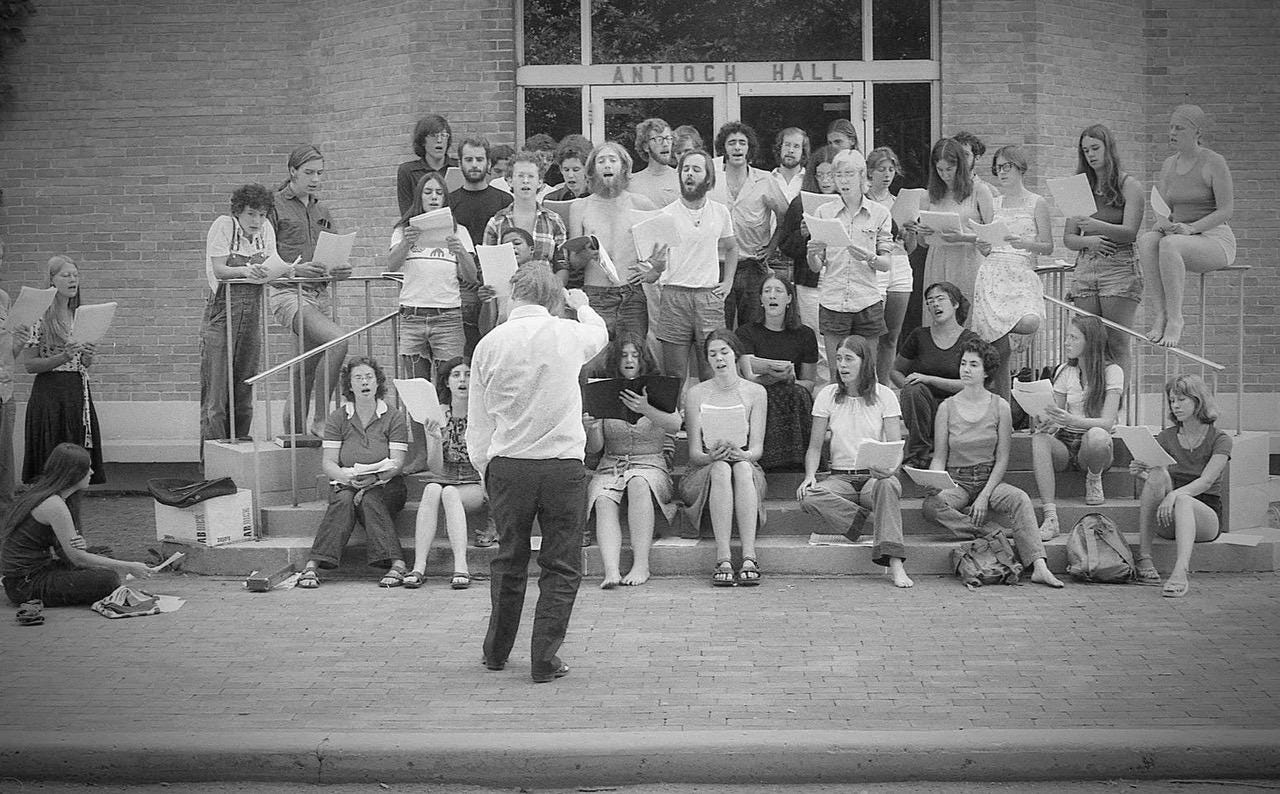
To be clear, the reason we were there at all was to travel Europe singing the works of Ockeghem, Dunstable, and Dufay. But this was a fully accredited Antioch academic term in need of a balanced curriculum, and the broadly conceived course syllabus for “Taste Perception”, with a major emphasis on the study of viticulture, would earn us five credits in Physical Science in addition to our credits in art and music.
“Tasting”, we would learn, engaged the sensors of the tongue ( sweet, sour, salty and bitter) as well as the olfactory senses. To do it “perceptively” involved extreme discernment.
And what were we told, time and again, was responsible for the nuanced layers of flavor in the foods and wines we were sampling for the first time?
“It’s the sirrl, people!!!!,” John would demonstrably exclaim. Yes the soil, (or “sirrl” as he would say with his oddly provincial Cadiz, Ohioan pronunciation.) We would learn that soil, or what the French call “terroir”— with its unique microbes and minerals dictated by its place of origin— is the foundation of earth’s abundance and lends identifiable distinction to everything we would taste.
∞∞∞∞∞∞∞∞∞∞∞∞∞∞∞∞∞∞∞∞∞∞∞∞∞∞∞∞∞∞∞∞∞∞∞∞∞∞∞∞∞∞∞∞∞∞
So it was certainly fitting that on a pleasantly temperate recent autumn morning, seven of those 56 students, now half a century older — Roger Stigliano ‘77, Laurie White ‘77, Jeff Treistman ‘76, Polly Young ‘79, Shannon Edwards ‘78, Mark Trexler ’78, and myself ’78 included; plus Susanne Johnson ’76, who went on the first chorus trip in ’73 — along with partners and spouses (including Mark’s wife, Laura Kosloff ’79), boarded a chartered mini-bus in front of their hotel in Alba, Italy, and set off on an excursion to Pascoli di Amaltea, an organic goat and sheep farm up in the hills, for a cheese tasting and tour.
It was a prelude, requested by some of us who craved a little something extra, to a reunion that would officially start the following day and would culminate with a nostalgic return to the village of La Morra.
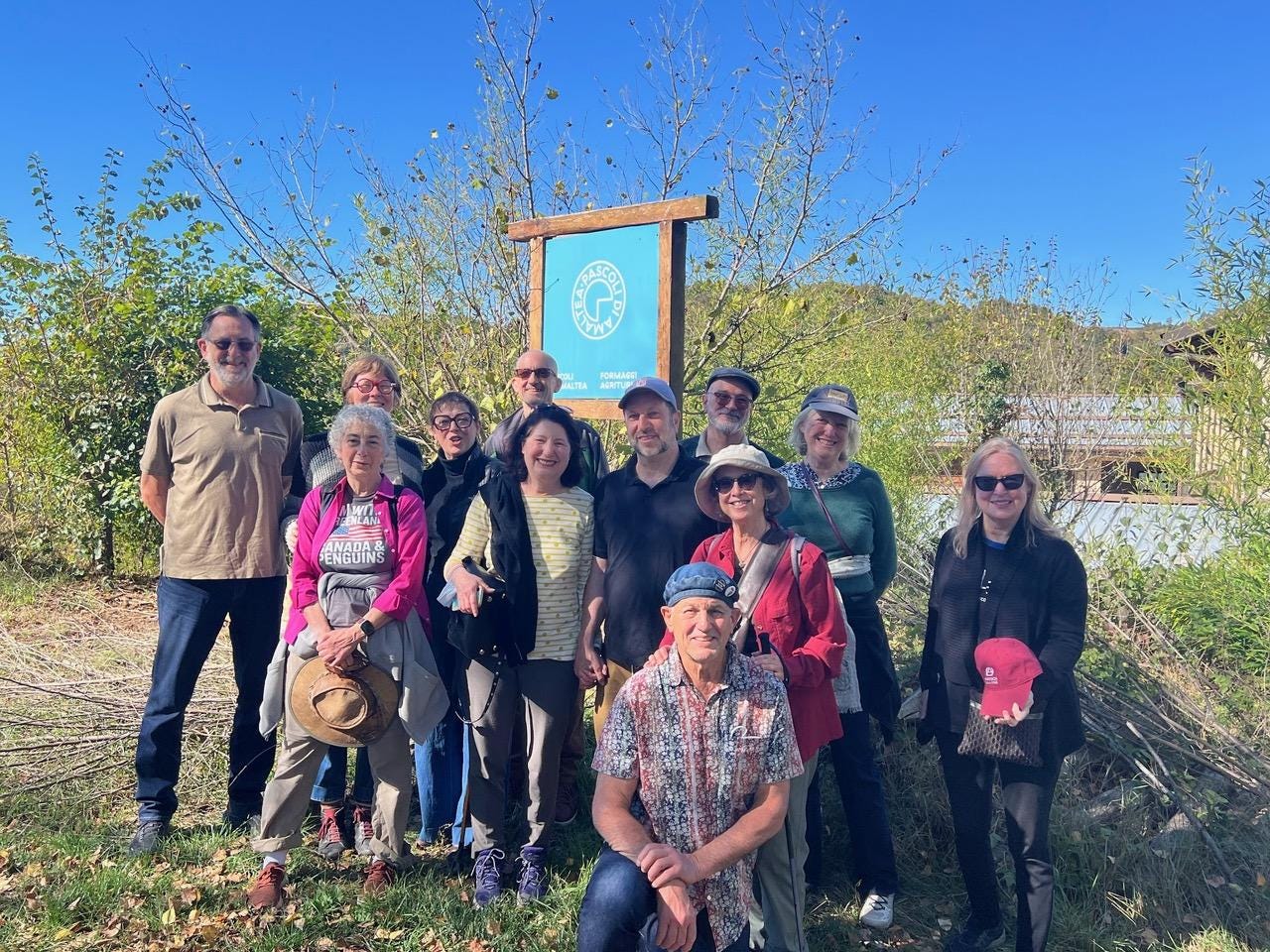
But on this day, Tuesday October 7th, 2025, we started our leisurely hour’s drive to the southernmost stretch of the province of Cuneo, past lush green fields, village houses, and vineyards that had just been harvested of their ripened grapes, up to the high country – the Alta Langhe – where the soil and terrain were far more conducive to raising sheep, goats, and cattle and rendering their milk into exceptional regional cheeses – than making wine.
Bruno, our affable driver, impressed us by maneuvering out of tight squeezes more than a few times that day. As we looked out our windows, the pastoral scenery speeding by, it was easy to daydream of our time as young students traversing France and Italy in a much larger bus, driven by a much more acerbic – yet equally smooth at steering an oversized vehicle – Gauloise-smoking Pierre. But when we eased into comfortable banter and sharing memories of years past – the dreams snapped into present tense, and our short journey felt reassuringly familiar in both its intention and its warm camaraderie.
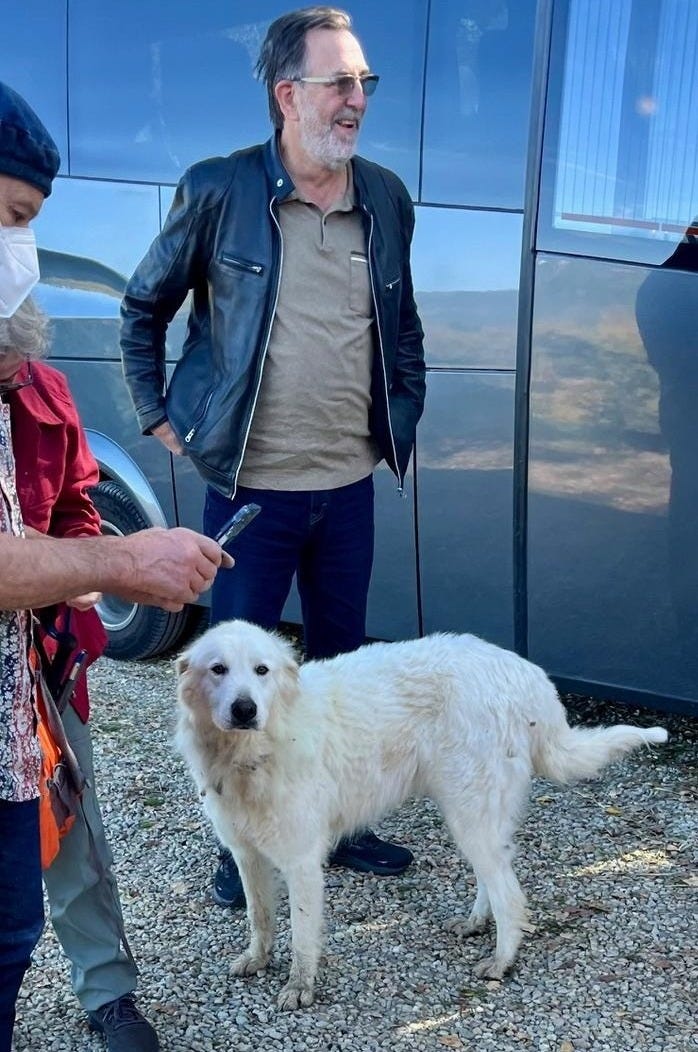
Before long we reached our destination, turned down a short dirt driveway and were welcomed by the friendly barking of Dixie and Brina, two older herding dogs relishing their recent retirement from their real job and their new pastime as “bus greeters.” Around the corner walked Arianna, who with her husband Alessandro ran the farm completely on their own, supplementing their income by offering tours to small groups such as ours.
Like us, Arianna was also an alumna – not of Antioch, but of the influential Slow Food movement which began on the Steps of Rome in 1986. A McDonald’s scheduled to open there fueled protests across Europe against fast food abomination and rallied a clarion cry to grow and make food the ancestral, or “slow” way.
This philosophy married so well to everything John Ronsheim had endeavored to teach us. (“Fast food, fast music – It’s all the same,” he once said, dismissing the expediency of pop culture. “It prevents growth, prevents depth!”) We felt like we had come home.
This movement’s headquarters eventually settled in the town of Bra, not far from our base in Alba – and Arianna and her husband carried the ethos of their work there to this beautiful rural outpost up the mountain. This meant that their farming and livestock husbandry practices were not just organic, but “regenerative.” They viewed themselves as stewards of the land as well as farmstead cheesemakers.
As our group, brimming with curiosity, strolled up the path to view sheep grazing below, she pointed out the different fenced corrals dividing their field and explained how the sheep were not allowed to rotate from one corral to the next without first finishing every blade of grass available to them. This meant eating even bitter and less palatable grasses that they would otherwise avoid, like children forced to eat their vegetables!

A sustainable practice such as this allowed the grazed meadows to “regenerate” holistically, retaining all the ecological diversity in that blessed soil – in turn giving the milk from these sheep and goats a sense of place and its unique taste, which would shift ever so subtlety with the change of each season.
We walked from the overlook back to the farmhouse to be given a tour of the cheesemaking facilities. Once inside, we peered through a glass door to the kitchen, noting the high level of sanitation that was required to produce their raw, or unpasteurized, cheeses; then on to the pantry where enticing rounds of cheese sat on racks drying and aging; and finally to their beautifully appointed rustic dining room for our much anticipated tasting.
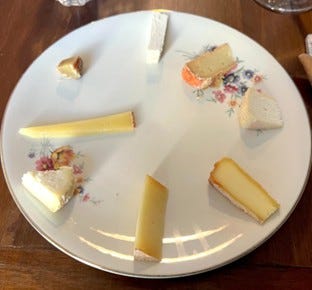
In the center of this small stonewalled room were thirteen green-backed wicker chairs set around a long oak dining table. At each place setting was a plate of small cheese wedges, arranged carefully around the edges like the hours of a formaggio clock! Each bite we took, in the proper order, was described by Arianna. There were goat and sheep single milk cheeses, such as the traditional round Tuma di Pecora delle Langhe; blends of the two; and samples of the same cheese, young and then aged – just like the French goat cheeses of varied maturation we tasted so long ago.
Dishes of goat sausage and home pickled vegetables followed, washed down with glasses of organic hard cider, brewed from apples harvested from trees that encircled the grazing fields. The denouement of our little feast was a dish of fresh goat ricotta drizzled with wildflower honey gathered from beehives on the farm. Delizioso!!!
We departed sated and contented, in stomach and in heart, some of us carrying jars of fresh honey or rounds of cheese. We then boarded our bus for a short drive up to the top of the hill and the Village of Mombarcaro.
Mombarcaro rests on the highest peak of the Langhe, which, on a clear day like this one, held vistas of the Italian Alps in the distance, and if you squinted hard enough – the Ligurian Sea on the horizon. We didn’t linger too long, but enjoyed grabbing a cappuccino, wandering through the lovely cobblestoned streets and taking in the outstanding views before heading back down the mountain.
However, one more stop along the way to Alba was in order. Polly had read about the Big Bench art installations that first appeared on hillsides nearby in the Piedmont region and spread to towns across Europe. This Instagram ready phenomenon placed Big Benches in scenic locations, and Bruno knew just the location to drive us to. Sure enough, just like he had promised, down a little path rested a giant bench overlooking a ridge. And of course we were all compelled to climb on to take the requisite photo.
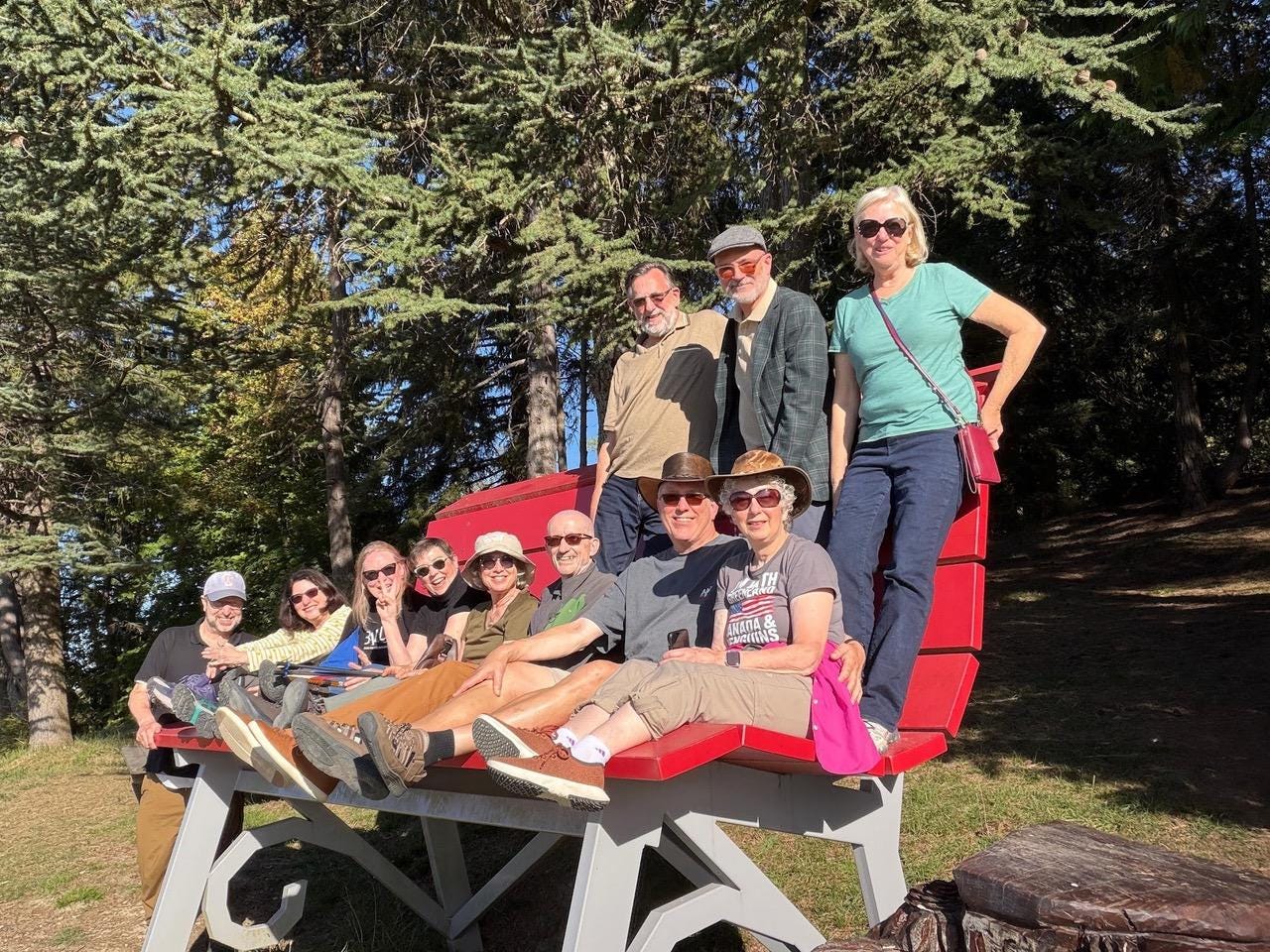
So here we sat on this Big Bench, which due to its outsized proportions created an illusion of us scrunched together like diminutive children – just as we suddenly felt we were again. A busload of kids, wandering through Europe and having the time of our lives.
This first day served as a delightful amuse bouche. A touchstone to our past and to the life-long lessons John Ronsheim imparted to us. When he would say: “We don’t use our senses with enough consciousness,” he was challenging us to observe deeply all that we see, hear and taste. That day, at Pascoli di Amaltea, and on the hilltop of Mambarcaro, we knew we did exactly that.
We returned to our hotel and couldn’t wait to see the rest of our chorus-mates who were arriving that evening; and to discover what new impressions we would glean from our surroundings, what new memories we could make all over again. Together.
**********************************************************************
— Sherri Roberts ‘78 (sherri@sherri-roberts.com) is a jazz singer who has resided, in very un-Antiochian fashion, within the same four block radius of San Francisco’s Haight Ashbury district since she left Yellow Springs, Ohio in the summer of ’79.
— If you are traveling in the Piedmont region of Italy and are interested in arranging a tasting tour of Pascoli di Almaltea farm, you can contact Arianna directly at hello@pascolidiamaltea.it or you can follow them on Instagram or Facebook.
