


In the waning days of 2020, in the midst of the social isolation that was the COVID epidemic, members of the 1975 Antioch Chorus European Tour received an e-mail from Laurie White ’77 inviting us to participate in an impromptu Zoom reunion. Unlike so many other Zoom groups that had formed around the country to break up our collective loneliness- this invitation had a more urgent underpinning:
One of our beloved chorus members, Charlie Doering ’77, a gifted math and physics professor at University of Michigan, had been diagnosed with terminal cancer and his 65th birthday was approaching.
Wouldn’t it be poignant timing, Laurie suggested, to gather together on Zoom, toast Charlie on his birthday and reminisce about the phenomenal experience we shared on our study term abroad? Maybe we could even sing along to our old recording of Johannes Ockeghem’s Missa Prolationum?
For the uninitiated, let’s back up - say nearly 50 years - and explain: What was this unique Antioch experience that bound us together over time?
In 1972, John Ronsheim, Professor of Music at Antioch College (from 1967-1990) — a visionary, eccentric, impish, brilliant twelve-tone composer with a passion for 15th Century Flemish Renaissance choral music — had an idea, one that made liberal use of Antioch’s propensity for freestyle education. “Almost every time I rehearsed the chorus,” he would later write, “I threw out the sentence, ‘We should perform these works in the places where they were first performed in Europe’.”
John would ultimately will this ambitious statement into existence; and he would not stop there. He envisaged a fully accredited academic term abroad with students touring multiple countries while studying art, food and wine; and, of course, singing — in churches small and large, after long lunches at vintners’ estates and in fields where the grapes were grown.
As his biographer/archivist Don Giller ’73 said, “What came out of all this was the ENORMOUS work John forced upon himself to turn [ his idea ] into a workable reality -- the trips to Europe beforehand to set up dates for vineyard tours and cathedral performances, hotel/hostel and restaurant reservations, the bus to cart everyone, the hundreds of letters he sent out, all in English, French, and Italian. The never-ending bureaucratic strings to untangle…”
Thus, thanks to the vision and determination of one Antioch professor, on June 25, 1973 the first Antioch College Chorus Tour left for Europe for a summer term abroad.
Then, two short years later, John was at it again. Only this time he had his initial successes and missteps upon which to build, the contacts in Europe he had established, and lessons learned from the first go-round.
He fleshed out a new itinerary with a more regimented course load (“twice or thrice the level of intensity and information,” he would say.) And with the logistical support of Antioch Education Abroad in Yellow Springs and France (Dominique Grossard - John’s essential intermediary to everything French) to plot out daily lodging and travel, etc., he rehearsed his eager charges in Kelly Hall in the Main Building on campus for nearly a year, culminating with an intensive summer quarter, in preparation for a journey that would have lasting impact on our lives.
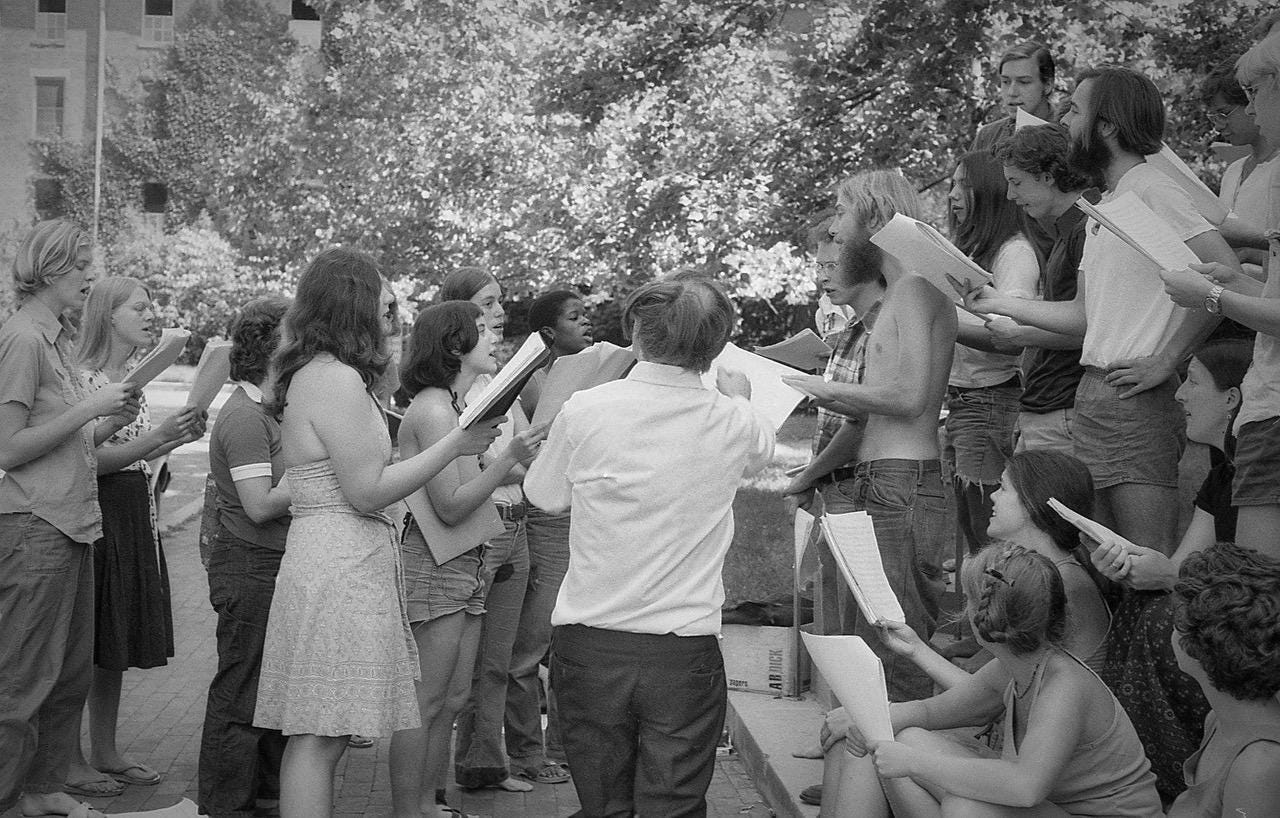
So on September 29, 1975, after singing an inaugural mass in St. Patrick’s Cathedral on 5th Avenue, the second Antioch Chorus European Tour embarked from New York City to Paris.
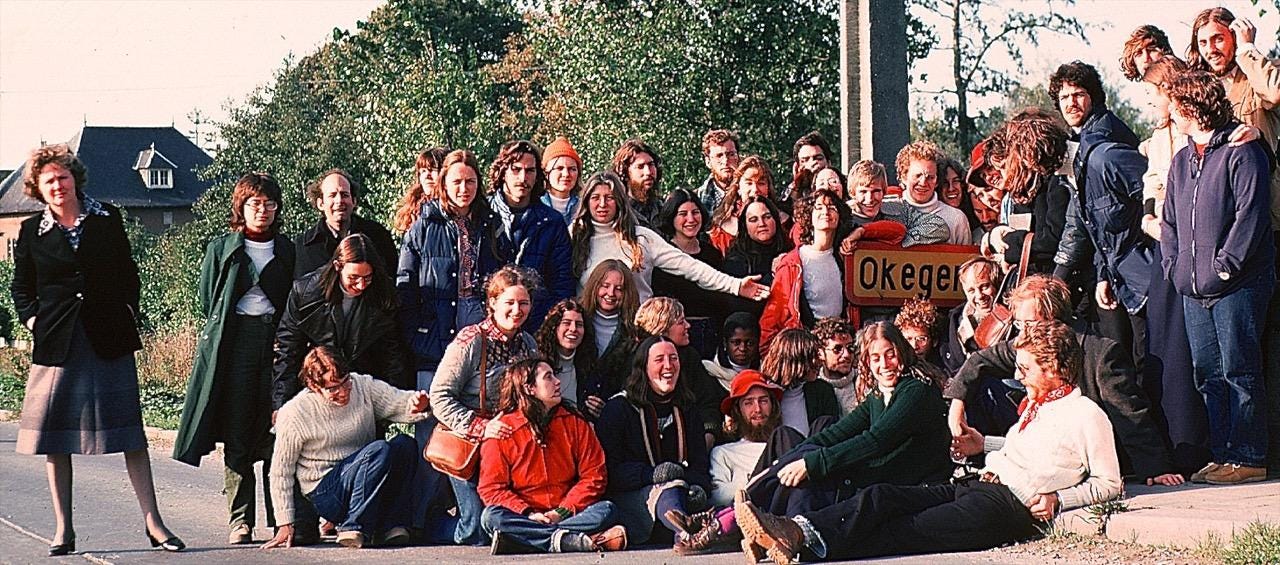
For the next 10 weeks, 60 of us traveled together on a bus through France, Belgium, and Italy. We studied Medieval, Renaissance and contemporary art; earned physical science credits for studying viticulture, including countless hours visiting vineyards and wine cellars while tasting and evaluating exquisite French and Italian wines; let our music serve as ambassador through performances that were planned or, occasionally, joyously spontaneous; but most remarkably, on each Saturday or Sunday, we sang Ockeghem’s mass in Latin in virtually every iconic cathedral in Europe, including Notre Dame, Chartres, Reims, Basilica Di San Marco in Venice, and the Duomo in Firenze.
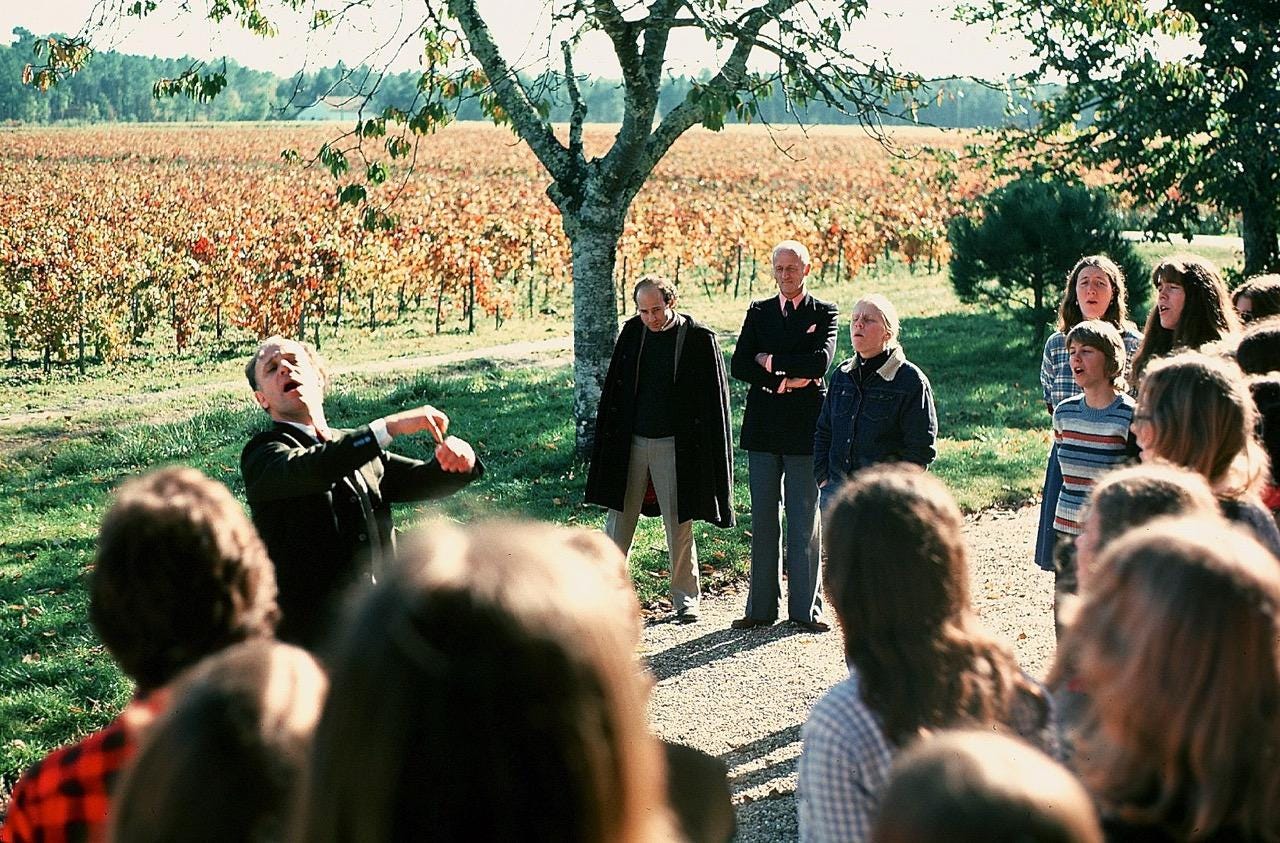
When John and his wife Eileen lived in Europe from 1956-1962, he experienced an awakening not afforded most Americans at a time when even television had barely penetrated their view of the outside world. As he pursued his study of musical composition (concentrating much of his time in Mallorca and in Florence with his mentor, twelve-tone composer Luigi Dallapiccola), he became captivated by a distinctly “European” aesthetic - a way of living that was integrally connected to the culture and the land (“terroir”.)
Throughout our tour, then, he made it his mission to pry open our senses to the unprocessed, unfiltered beauty of food, wine, art and music, while coaxing us to receive these gifts consciously (“This was given to us,” he would say. “We didn’t take it. It was given to us!”) - recognizing the skill, integrity and, most importantly, soul that went into their creation.
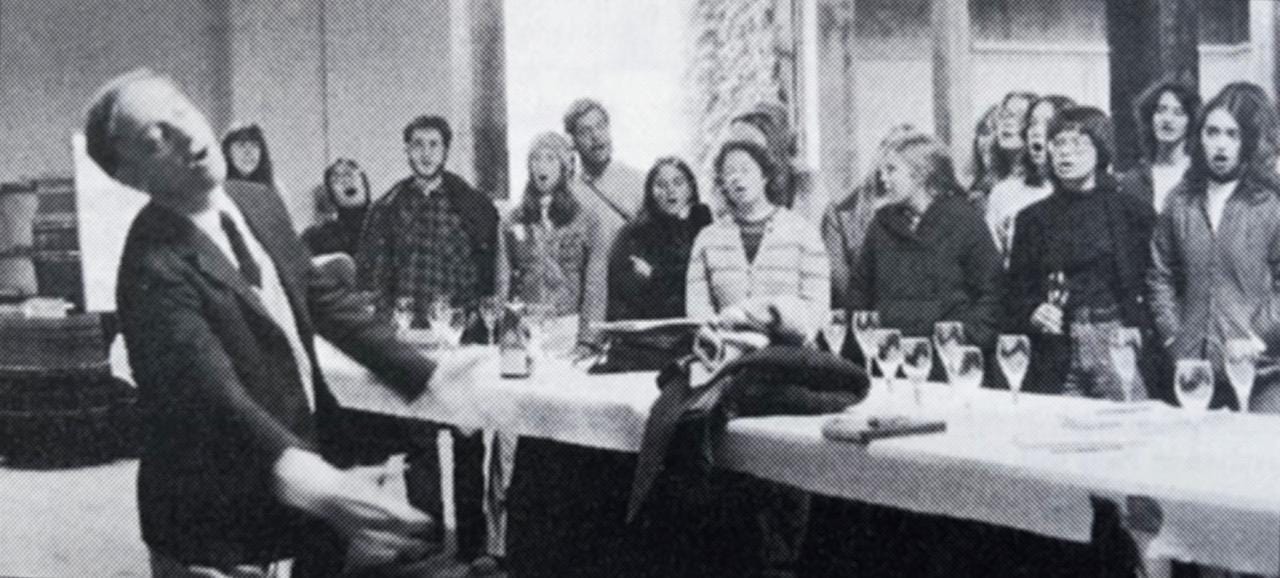
He wanted to share in delights he himself had discovered as a younger man abroad and, in Laurie’s words, “transmit to us that which had brought him fully alive.” As 18 to 21 year olds, not yet worldly nor wise, we were all in!
John Ronsheim became our spirit-guide, tempting us with the sweet taste of aged balsamic vinegar poured onto the back of our hands, the earthy aroma of a fresh truffle shaved over a bowl of warm toothsome risotto, the sounds of cathedral bells ringing in the hollows of an ancient village, the rich ruby iridescent tint of a vintage Bordeaux swirling around the crystalline edges of a wine glass, the come-hither gaze of Donatello’s David under his rakish cap, and the stunning, impossible beauty of interlocking polyphonic melodic motifs, that would reach a crescendo as our voices, pure and untrained, joined in sonic-oneness.
These and too many more astonishing moments were the indelible experiences we were blessed to share.
∞∞∞∞∞∞∞∞∞∞∞∞∞∞∞∞∞∞∞∞∞∞∞∞∞∞∞∞∞∞∞∞∞∞∞∞∞∞
So when that fateful Zoom call/reunion rolled around, and we celebrated what would be Charlie’s final birthday with anecdotes, stories, songs and laughter about our unique time together as young students abroad - out of those stories and subsequent Zooms one particular memory emerged: La Morra, Italy.
La Morra was hardly the only small village we had journeyed through, but it was the only “off the beaten path” hamlet that had warmly invited us - with open, hospitable arms - to stop, settle a moment, and smell the Barolo.
What seared its allure into our collective memories was the unforgettable meal, studded with fresh truffles, in Gian Bovio’s Belvedere Ristorante; the beauty of a Medieval hillside village perched on top of cascading terraced vineyards; the charm of our hosts and the adorable school children with whom we exchanged song (“peeking out from the corners of the church like living cherubs”, Roger Stigliano ‘77 exclaimed); and the kindness of the townspeople who housed all 60 of us for two special days. Yes, there were no hotels or pensiones in La Morra - but, astoundingly, John found a way for all of us to be welcomed individually into the humble homes of Lamorresi.
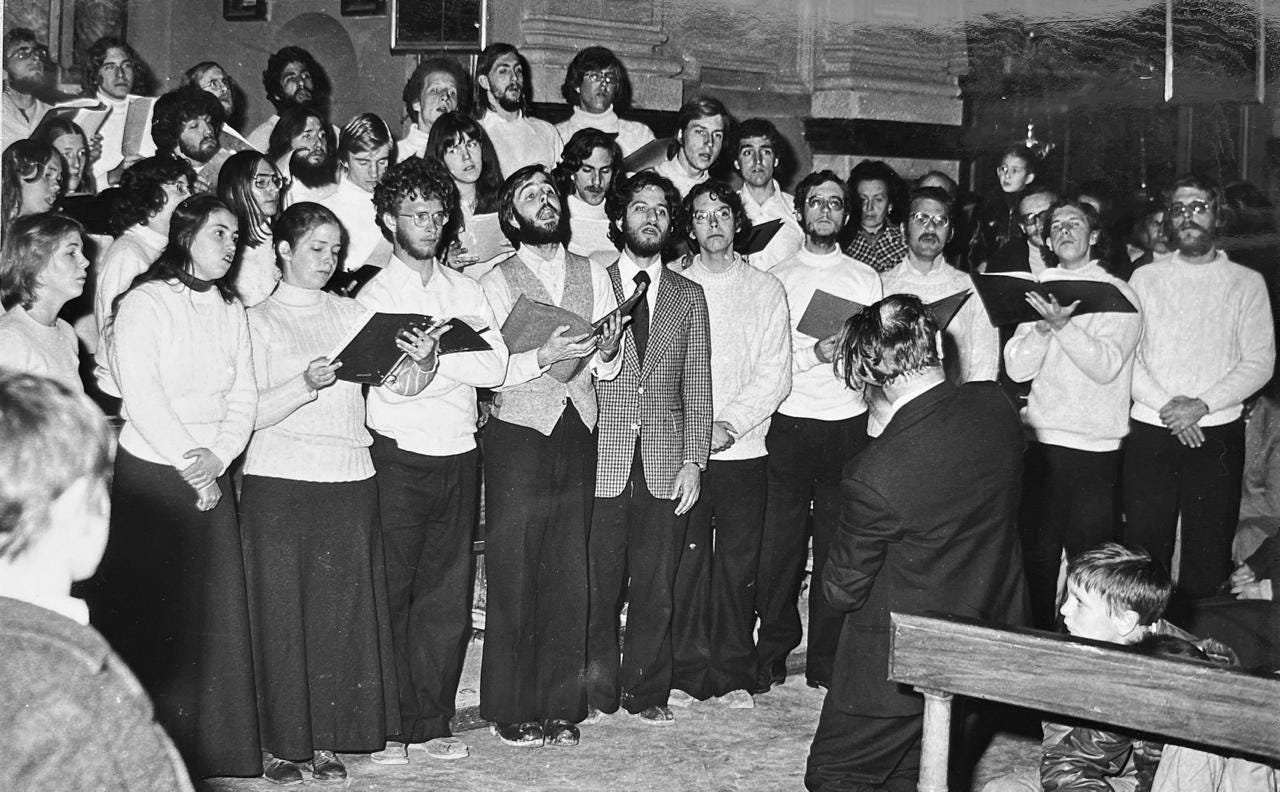
Sharing these memories via Zoom had another effect that none of us anticipated. We were still in the confining days of COVID lockdowns, and armchair traveling was an essential pastime. We were all becoming restless and longed for some imagined goal or destination to lean into when the world opened up again.
La Morra, and a reunion of the 1975 chorus to take place there, became that goal.
Swept up in a nostalgic urge to go exploring again, I was the first to present this proposition to others. Laurie White, a family therapist and filmmaker from Ann Arbor, and Roger Stigliano, a lawyer and filmmaker residing in L.A., were quick to jump on board; followed by Shannon Edwards ’78, a retired theatre professor who had led multiple student trips abroad, and Rick Ray ’75, the unofficial chorus archivist and historian who had organized the only Yellow Springs reunion of both chorus tours in 1996, a year before John’s unexpected death. And finally, Jeff Treistman ’76 and Polly Young ‘79, who had hosted the last “in person” (West Coast) chorus reunion at their wine-centric Seattle cafe in 1998 (and who still had connections to wine producers in the Piemonte region) joined in the fray.
Together we formed an ad-hoc “Steering Committee,” that would labor and stumble over the next four years, searching for a way to make this La Morra reunion happen, while gaining new appreciation for John Ronsheim all over again - recognizing how absurdly hard it is to organize a three-day tour, let alone a three-month one!
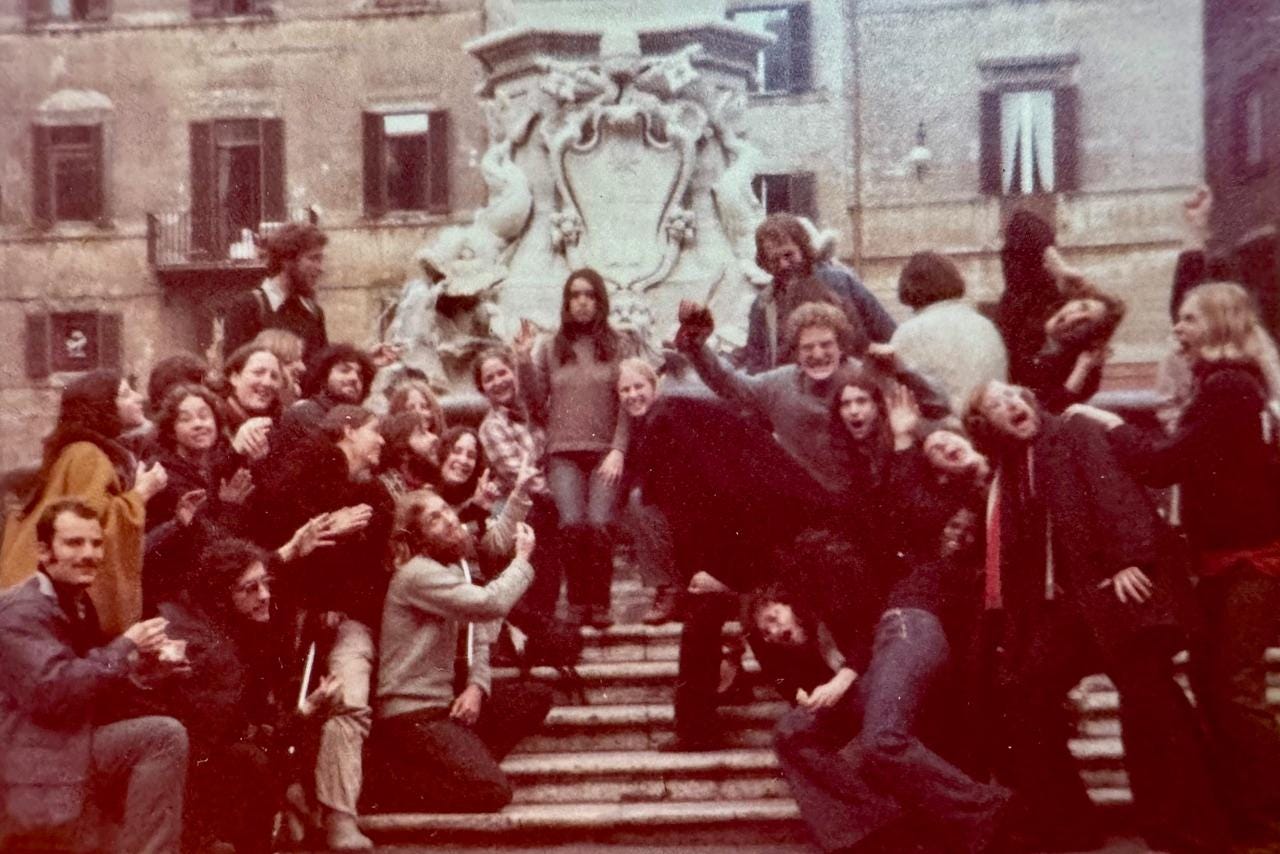
In these ensuing years we would also learn that while La Morra and four other adjacent hillside villages had been declared “UNESCO World Heritage Sites” and would physically appear to us as we mostly remembered them, the entire Langhe region had since become a magnet for Gastro-Tourism, due to its outstanding wines and the International Truffle Festival drawing thousands to the central town of Alba annually.
Undaunted, we enlisted the services of a local tour guide, Silvia Aprato of Tasting Tours, to create a two-day itinerary of wine tasting and dining, customized to reflect the type of activities we would have experienced as students, and culminating with our return to La Morra. We vowed to brush up on our Ockeghem, Dufay, and Dunstable. And at the request of some, I added an extra day up front to visit a “Slow Food” goat and sheep farm in the high hills, Alta Langhe, where organic cheeses were handmade.
The Steering Committee agreed on several parameters: The reunion needed to be affordable; it would happen in the fall at the beginning of truffle hunting season; and the year would be 2025 - exactly 50 years after we first stepped foot in La Morra.
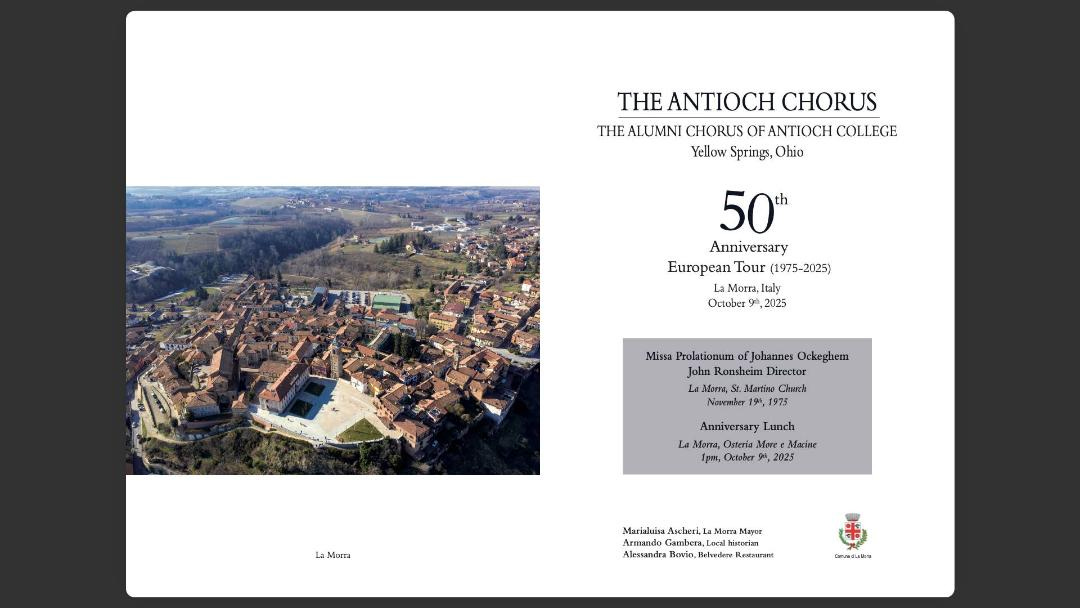
When the program finally came together, these are the other chorus members who signed on: Adam Haas ’77, Richard Robinson ‘77, John Pacht ‘76, Michael Kerner ’76, Joanna Gerngross Hediger ‘79, Susanne Johnson ’76 and Mark Trexler ’78. Mark’s wife, Laura Kosloff ’79, along with various other partners and spouses, brought our number to 22.
The date was set. On the week of October 6th, 2025, we would all meet up at Hotel I Castelli in the town of Alba, a few kilometers away from La Morra, to begin our good old fashioned Antioch Adventure.
——- Sherri Roberts ’78 (sherri@sherri-roberts.com) is a jazz singer who has resided, in very un-Antiochian fashion, within the same four block radius of San Francisco’s Haight Ashbury district since she left Yellow Springs in the summer of ’79.
